





Disclaimer
This analysis is based on personal trading experience, practical orderflow observation, and independent research. The views expressed are for educational purposes only and reflect the author’s understanding of market behavior. Copying or reproducing this paper, in whole or in part, is strictly prohibited
Why Most Traders Fail (Even After Learning Orderflow)
By now, you already understand key concepts like Auction Zero, imbalance, POC, and volume participation. On paper, this should be enough to build consistency. Yet in reality, most traders still struggle.
The reason is simple — not lack of knowledge, but lack of structured interpretation.
Most traders read orderflow in isolation. They open a footprint chart, notice imbalance or aggressive buying/selling, and immediately form a directional bias. When trades fail, the conclusion is predictable:
“Orderflow is not working.”
But the truth is — orderflow is working exactly as it should.
The real issue is this:
You are reacting to activity, instead of understanding where and why that activity is happening.
Most traders are not wrong — they are simply incomplete. They see the same data, but they interpret it without structure.
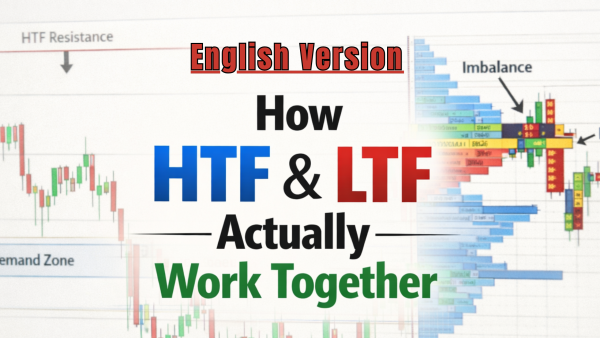
Understanding HTF and LTF — The Right Way
Before going deeper, this distinction must be absolutely clear.
The Higher Timeframe (HTF) in this framework refers specifically to the 15- 30 minute chart. This is not just a timeframe — it is your context engine. It tells you where price is positioned within the broader auction, whether the market is accepting or rejecting prices, and whether continuation is sustaining or beginning to weaken.
In simple terms:
HTF answers the question — “Why should a trade even exist here?”
On the other hand, the Lower Timeframe (LTF) — the 5-minute orderflow — is your execution layer. It shows what participants are doing in real time: who is aggressive, who is absorbing, and whether that activity is actually producing results.
LTF answers — “Is the current behavior confirming my HTF expectation?”
This distinction alone separates random trading from structured decision-making.
Auction Zero — Where the Story Changes
One of the most misunderstood concepts among traders is Auction Zero.
Auction Zero does not mean immediate reversal. It simply indicates that a continuation attempt has failed to gain acceptance. The market tried to move in one direction but could not sustain that move.
This tells you something very important:
The previous direction is no longer being accepted with the same ease — at least temporarily.
At this stage, a common question arises:
“If continuation failed, should I immediately take the opposite trade?”
The answer is no.
Auction Zero is not a signal — it is a condition change. It tells you to shift from assumption to observation.
Why HTF Alone Is Not Enough — And LTF Alone Is Misleading
If you rely only on HTF, you will develop correct bias but poor execution. You may understand that continuation is weakening, but without confirmation, entries become early and inefficient.
If you rely only on LTF, you will constantly see activity — imbalance, high participation, aggressive buying or selling — but without context, all of it becomes misleading.
This is where most traders get trapped in confusion.
Let’s pause and think:
If you see strong buying on LTF, does it always mean price will go up?
Not necessarily.
Now the real question becomes:
Why does strong buying sometimes fail?
To answer that, you need HTF.
The Shift in Interpretation — When Context is Added
Without HTF, you might see:
- High buy percentage
- Visible imbalance
- Strong participation
And conclude:
“Buyers are strong.”
But once HTF context is added, the same situation can look very different:
- Price is near an Auction Zero zone
- Price is stretched away from POC
- Total volume is already elevated
- Buyers are active, but price is not moving higher
Now the interpretation changes to:
“Buying is active, but not effective.”
This shift — from activity to effectiveness — is where real understanding begins.
The Core Concept: Effort vs Result
At the heart of professional orderflow analysis lies one simple idea:
Markets do not move based on effort — they move based on result.
Effort includes:
- Imbalance
- Buy/Sell percentage
- Total volume
Result includes:
- Price movement
- Continuation
- Acceptance
When effort and result align, the market behaves cleanly.
But when effort is high and result is weak, something important is happening.
At this point, you might naturally think:
“If buyers are aggressive, price should go up.”
Exactly. That is the expectation.
And when that expectation fails, it reveals information.
The activity is not translating into outcome.
This is where most traders lose clarity — because they try to force direction from activity instead of asking whether that activity is working.
This condition is what we call inefficiency.
How to Read the Market — The Professional Sequence
At a professional level, trading is not about finding signals — it is about identifying conditions where signals actually matter.
At this point, everything comes together into a structured process.
First, identify whether Auction Zero is present on the 15-minute chart. If continuation has not failed, there is no reason to question the current direction.
Next, observe the position of price relative to POC. If price is stretched away from fair value, the market is operating inefficiently and may seek balance unless supported by strong acceptance.
Then evaluate participation using volume percentage.
This is where a critical understanding is required.
Volume percentage on HTF does not just show activity — it reflects which side is dominating participation and aggression.
At this point, a common misunderstanding must be cleared.
High buy percentage does not automatically mean the market will go up, and high sell percentage does not guarantee a move down.
Volume percentage reflects aggression, not success.
If buyers dominate, they are the aggressive party. If sellers dominate, they are aggressive.
However:
As a rule, we do not blindly trade against the dominant participant.
We observe whether their participation is being accepted or rejected by price.
If price moves with them, their activity is effective.
If price does not respond, their activity is being absorbed.
This is the difference between:
Participation and outcome.
After that, assess total volume.
High volume shows commitment — but commitment must be validated through price response.
Finally, observe imbalance — not as a signal for direction, but as an indication of initiative activity.
Once this entire HTF framework is clear, only then shift to LTF.
What LTF Is Actually Meant to Do
The role of LTF is not to generate ideas.
It is to validate what HTF has already suggested.
At the HTF-defined location (especially near Auction Zero), you observe:
- Is aggression continuing or weakening?
- Is price responding to participation?
- Is activity producing outcome, or failing to do so?
In other words:
Is current behavior aligned with HTF expectation?
Only when this alignment appears does probability improve.
Answering Common Doubts
A common question is:
“Why not trade every imbalance?”
Because imbalance shows participation, not outcome. Without context, it is incomplete information.
Another question:
“Why is Auction Zero so important?”
Because without a failed continuation, there is no structural reason to question the existing direction.
Many traders also ask:
“Why focus on volume percentage?”
Because candles show what happened, but volume percentage shows who is participating and how aggressively.
It tells you who is trying — not whether they are succeeding.
And perhaps the most important question:
“Why does strong buying sometimes fail?”
Because markets move on effective participation, not just aggressive participation.
Final Framework
At a professional level, trading reduces to one simple alignment:
HTF Location + LTF Behavior = High Probability Condition
HTF defines:
- Auction Zero
- POC location
- Participation (buy/sell %)
- Total volume
- Imbalance context
LTF confirms:
- Whether that participation is effective
- Whether price is responding
- Whether conditions are aligning
Final Thought
Most traders try to predict direction.
Professionals evaluate conditions.
The market does not reward what appears strong —
it rewards what is actually working.
HTF tells you what should happen.
LTF tells you whether it is happening.
When both align, you are no longer guessing.
You are operating with structured understanding.
One Line to Remember
No Auction Zero → No Trade
Auction Zero + Inefficiency + LTF Alignment → High Probability Condition
If you notice any discrepancy in this article or have questions regarding the concepts discussed, please contact the admin at sg@orderflowwithsg.com or connect with us through our Telegram channel.

Thanks for the clarification. But it’s known that all setups don’t guarantee 100% wins. Probability above 60% is good enough?
thanx for this information but adding examples will be more helpful
best setup for all type market\ like trending or sideways \ thanks for pure knowledge
Great knowledge at best! Really helpful and informative!!Thank you Sh. S. G!!