









Disclaimer
This analysis is based on personal trading experience, practical orderflow observation, and independent research. The views expressed are for educational purposes only and reflect the author’s understanding of market behavior. Copying or reproducing this paper, in whole or in part, is strictly prohibited
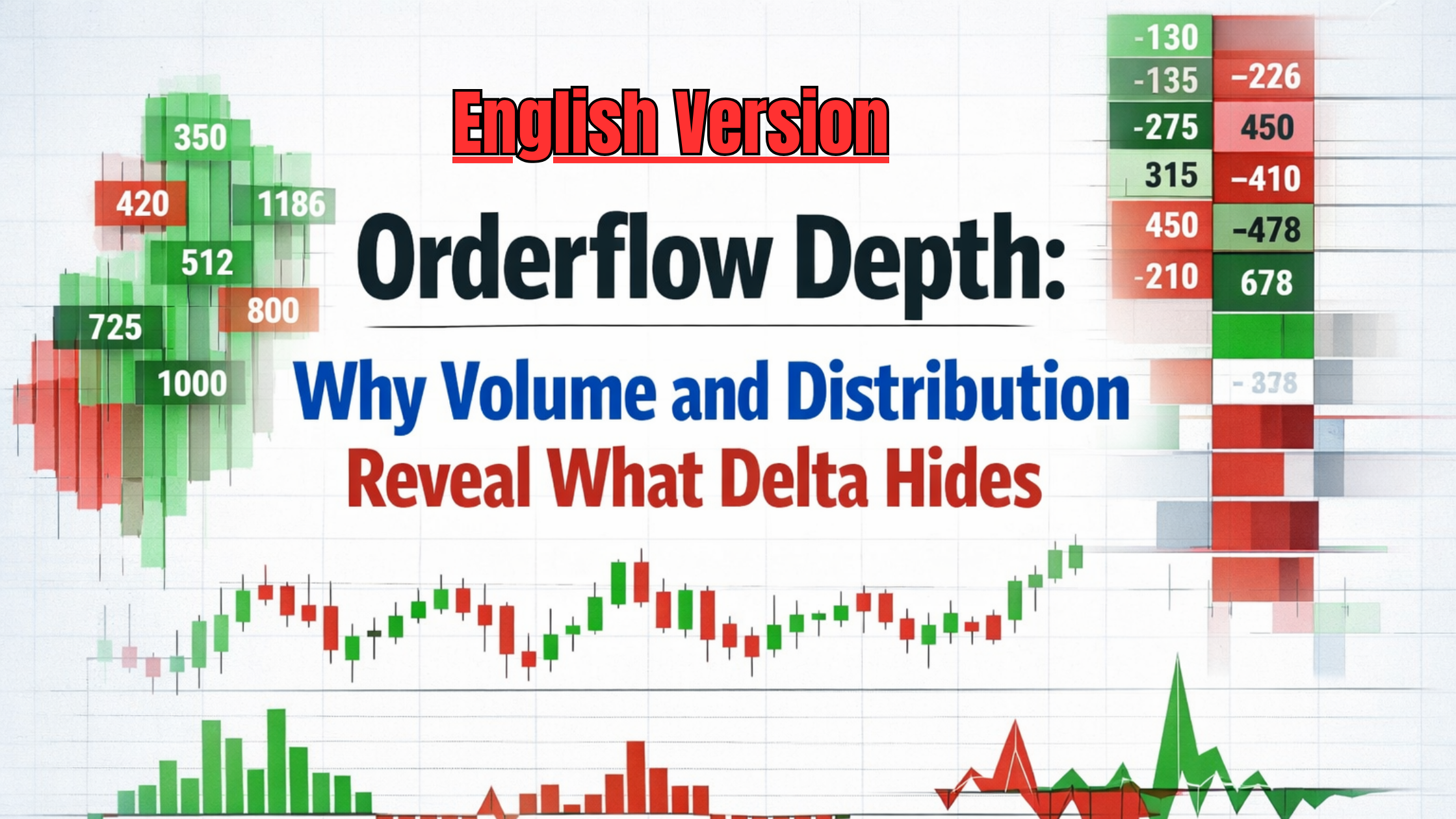
Orderflow Depth: Why Volume and Distribution Reveal What Delta Hides
Most orderflow traders rely heavily on candle delta.
If delta is positive → buyers were more aggressive.
If delta is negative → sellers were more aggressive.
That interpretation is not wrong.
But it is structurally incomplete.
Delta is popular because it simplifies market activity into one clean number.
And simplicity is attractive.
The problem is this:
A candle is not defined only by who pushed more.
It is defined by how much participation stood behind that push.
To properly understand what happened inside a candle, we must separate three distinct questions:
- Delta answers: Who was more aggressive?
- Total volume answers: How much participation occurred?
- Buyer/Seller % answers: How was that participation distributed?
Delta answers only the first question.
Total volume and participation percentage reveal the structural depth that delta compresses.
1️⃣ What Candle Delta Actually Measures
Candle delta is calculated as:
Market Buy Volume (–) Market Sell Volume
It measures aggressive order imbalance.
In microstructure terms, delta reflects the difference between buyers lifting offers and sellers hitting bids.
That tells us something important:
- Which side was more aggressive
- By how much aggression differed
But delta does not tell us:
- The overall scale of participation
- Whether dominance was mild or extreme
- Whether imbalance occurred in a thin or highly active environment
Delta reflects imbalance.
It does not reflect participation scale or internal structure.
That distinction is critical.
2️⃣ Distribution Matters More Than Difference
Delta gives you a difference value.
Buyer % and Seller % reveal how participation was distributed inside the candle.
Let’s examine two candles with identical delta.
Candle A
Total Volume = 10,000
Buyers = 6,000
Sellers = 4,000
Delta = +2,000
Buyer % = 60%
Seller % = 40%
Here, buyers are dominant, but sellers remain meaningfully involved.
Participation is broad.
Dominance is moderate.
Candle B
Total Volume = 4,000
Buyers = 3,000
Sellers = 1,000
Delta = +2,000
Buyer % = 75%
Seller % = 25%
Delta is the same: +2,000.
If delta were the only reference, both candles would appear identical.
But structurally they are very different:
- Candle A shows wider participation with balanced opposition.
- Candle B shows smaller participation with stronger skew.
Buyer/Seller percentage exposes the internal dominance intensity.
Delta alone hides that distribution.
A Simple Analogy
In a room of 10 people, 7 support one side → 70%.
In a stadium of 1,000 people, 550 support one side → 55%.
Both show majority.
But the dominance intensity and participation scale are not the same.
Total volume shows scale.
Buyer/Seller % shows intensity.
Delta alone cannot clearly communicate both dimensions.
3️⃣ Scale Changes Interpretation
Now consider two candles with the same delta again.
Candle A
Total Volume = 5,000
Delta = +1,500
Candle B
Total Volume = 25,000
Delta = +1,500
Same delta.
Completely different environments.
In Candle A:
+1,500 represents a large portion of total activity.
In Candle B:
+1,500 represents a much smaller share of overall participation.
Without checking total volume, delta can:
- Make a low-participation candle appear significant
- Or make a high-participation candle appear ordinary
Total volume provides scale.
Delta does not.
4️⃣ Why This Distinction Matters
Aggressive imbalance has meaning only in context.
In high-participation environments, even moderate imbalance can drive movement.
In low-participation environments, large imbalance may lack durability.
Delta by itself cannot differentiate these conditions.
It compresses structure into a single net number.
Total volume and participation percentage preserve that structure.
They show:
- How many participated
- How strongly participation was skewed
- Whether activity was broad or thin
That is deeper information.
5️⃣ The Structural Difference
Delta isolates imbalance.
Volume reflects participation intensity.
Percentage reveals internal dominance.
When scale and distribution are ignored, interpretation becomes shallow.
When they are considered, the internal structure of the candle becomes clear.
This is not about dismissing delta.
It is about recognizing its limitation as a reduced representation of a more complex participation process.
Final Conclusion
Per-candle delta is useful.
But it is structurally compressed by design.
It shows the difference between aggressive buyers and sellers,
yet it does not show:
- The scale of participation
- The proportional dominance
- The distribution of activity within that scale
Total candle volume and buyer/seller percentage retain that structural detail.
Delta answers: who pushed more.
Volume and percentage answer: how much and how strongly.
For anyone seeking deeper understanding of participation — not just directional imbalance — total volume and buyer/seller percentage provide clearer insight than delta alone.

-
-
-
-
-
-
Show CommentsA very clear explanation of participation using buy vol and sell vol percentages, where delta cannot replace it. Please add on effectiveness of delta/vol percentage also
Good study sir ji…acha hai…
Nice write up!!
While shwg Deltas limitations, you have clearly brought up the associated data for interpretation.
This shows the more the data items the better interpretation but our philosophy has been to keep it simple.
Very easy to understand explanation. Thanks SG!
Yes, concepts are better understood. These articles are must read. Precise information, simple language and easy to understand.
the way you broke down every single layer with such precision is mind blowing..thank you for this masterfully written explaination!!