







Disclaimer
This analysis is based on personal trading experience, practical orderflow observation, and independent research. The views expressed are for educational purposes only and reflect the author’s understanding of market behavior. Copying or reproducing this paper, in whole or in part, is strictly prohibited
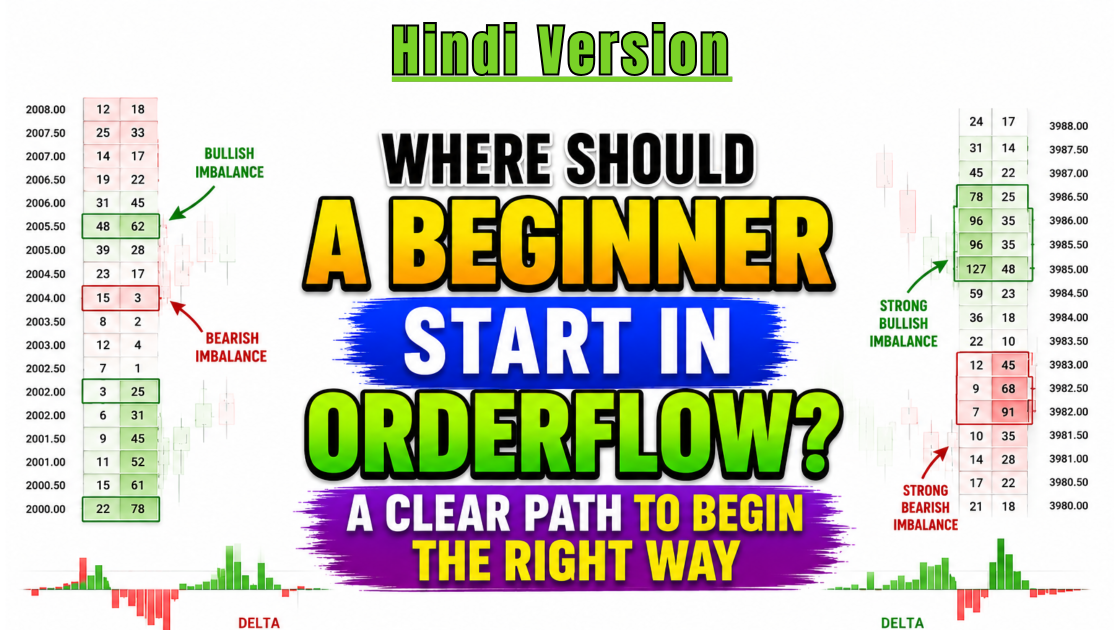
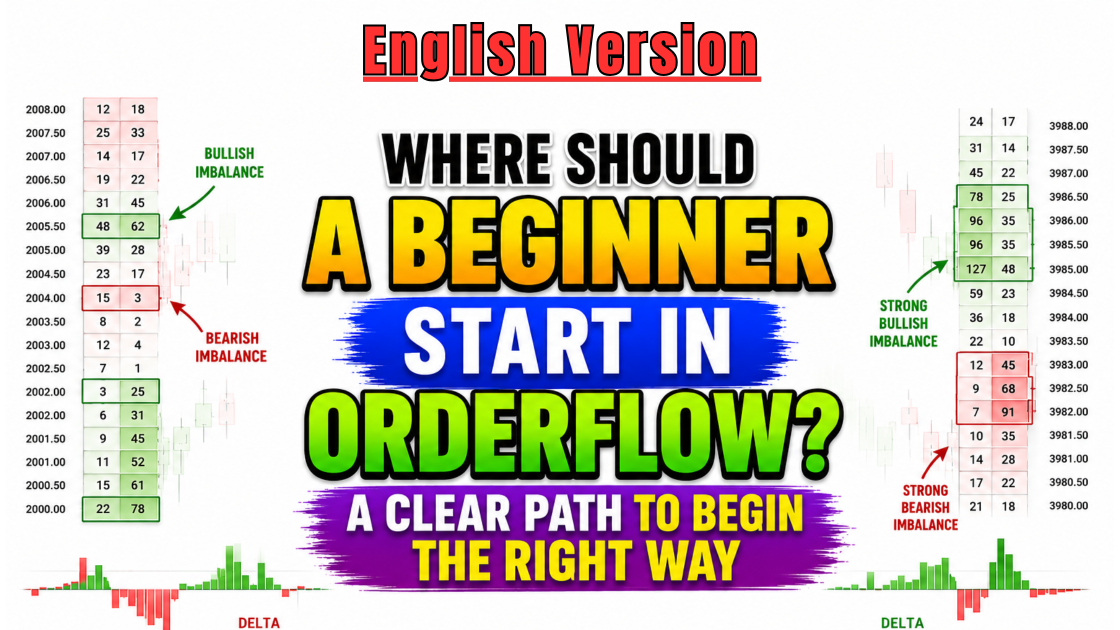
Where Should a Beginner Start in Orderflow? A Clear Path to Begin the Right Way
Most beginners don’t struggle because orderflow is difficult. They struggle because they start at the wrong place.
They open charts, explore imbalances, try to follow volume — and very quickly feel lost. Not because they are incapable, but because they are trying to understand everything at once.
Most traders don’t fail because markets are random. They fail because they try to understand advanced concepts without building the base.
Orderflow is not something you “pick up.” It is something you build step by step.
This article is not here to teach setups or entries.
Its purpose is simple: to give you clarity on where to begin, what to focus on, and what to realistically expect as you start learning these concepts.
First, Understand This — Orderflow Takes Time
Before you begin, it’s important to set the right expectation.
You will not understand orderflow in a few days.
In the beginning:
- Charts may look messy
- Concepts may feel disconnected
- You may question whether it is even working
This phase is completely normal.
Because what you are learning is not just a tool or an indicator. You are learning how the market behaves internally, how participation, intent, and movement are connected.
Once you accept this, learning becomes smoother. Without this clarity, most people quit too early.
Step 1: Begin with Auction Zero (HTF)
Your starting point should always be Auction Zero on HTF (Higher Timeframe).
HTF simply means the bigger picture, charts like 15-minute, 30-minute, 1-hour, or daily.
Why this is the first step
Before thinking about entries or signals, you need to understand:
Where is the market currently operating?
This is where most traders go wrong, they look for entries without understanding where the market is positioned.
Auction Zero helps you recognise when the market is:
- Moving away from previous value
- Testing a new area
- Accepting or rejecting that shift
It acts as a reference point, not a signal.
What you should expect at this stage
In the beginning, you may not mark Auction Zero perfectly. That’s completely fine.
Your job is not perfection.
Your job is observation.
Spend time watching:
- How price behaves around important areas
- How it reacts when it moves away from them
Slowly, something interesting starts happening.
You begin to notice:
“Some areas matter more than others.”
That moment when charts stop looking random is your first real progress.
Common doubt
“Do I need to master this before moving ahead?”
No. You only need basic familiarity. Clarity develops as you move forward.
Step 2: Move to POC (Point of Control) & Effort vs Reward
Once you are comfortable with the bigger picture, the next step is POC (Point of Control).
POC simply means: The price where the highest trading activity (volume) happened.
It is essentially an area of maximum agreement between buyers and sellers.
Why this comes next
Now you shift from:
- Where the market is
to - How the market is behaving at that location
What you will experience as a beginner
Initially, most people assume:
- High volume = strong move
But as you observe more, you will notice something different:
- Sometimes price does not move even with high volume
This is where the idea of Effort vs Reward becomes important:
- Effort = Volume
- Reward = Price movement
What you should focus on here
Don’t try to trade based on POC.
Instead, start noticing: “Is the effort actually producing a result?”
At first, this may feel unclear. With time, this becomes one of the most important observations in orderflow.
Common doubt
“Should I mark every POC?”
No. Focus on understanding behaviour, not marking everything on the chart.
Step 3: Introduce Imbalance — But With Patience
Now you can begin exploring Imbalance.
This is the stage where most beginners rush and end up confused.
What imbalance represents
It highlights moments where:
- Buyers or sellers are acting aggressively
Naturally, this attracts attention.
But here’s what you need to understand early
Imbalance is not a shortcut.
This is why many traders feel imbalance “works sometimes and fails randomly.” In reality, the issue is not imbalance it is how it is being used.
What you should expect
In the beginning:
- You will spot many imbalances
- You may feel they should all lead to movement
But they won’t. And that is where learning actually begins.
Your approach at this stage
Don’t focus on trading every imbalance.
Focus on understanding:
- Why some imbalances lead to movement
- Why some do not
Gradually, you will start connecting this with:
- Location (from Auction Zero)
- Behaviour (from Effort vs Reward)
That’s when imbalance starts making sense in a practical way.
Common doubt
“Why does everything look clear in hindsight?”
Because context becomes obvious after the move. Learning is about recognising it before.
Step 4: Volume Interest & Participation — Understanding Activity
As you progress, your learning shifts from observation to interpretation.
Your focus now moves to:
Volume Interest and Participation.
What this stage is about
Understanding:
- When market activity increases
- Who is more active — buyers or sellers
What to expect here
This stage may feel slightly difficult in the beginning.
You may not always clearly identify:
- Who is in control
- Why price is reacting in a certain way
That’s normal.
The real shift happens here
You stop seeing charts as patterns or indicators.
And you start seeing them as: People making decisions in real time.
This is where your understanding becomes more practical and less theoretical.
It doesn’t come instantly, it develops with observation and screen time.
Step 5: Risk vs Reward — Start Taking Trading Seriously
Once you reach this stage, one principle becomes essential:
You must respect Risk vs Reward.
Even the best understanding fails without proper risk control.
What it means
- Risk → What you can lose
- Reward → What you aim to gain
What beginners usually expect
Many believe:
- Better understanding = more winning trades
But that’s not how markets work. Even with good understanding:
- Some trades will not work
What you should focus on
- Avoid taking random trades
- Avoid forcing entries
- Keep your risk controlled
What you will experience
You may miss trades.
You may hesitate.
This is part of building discipline.
Long-term consistency comes from control not frequency.
How Everything Connects (Big Picture)
If you follow this learning path with patience, everything will slowly start connecting:
- Auction Zero → Gives you context
- POC → Shows where activity is
- Effort vs Reward → Shows strength or weakness
- Imbalance → Shows intent
- Volume Participation → Shows control
- Risk vs Reward → Keeps your trading sustainable
At first, these may feel like separate ideas. Over time, they begin to form a complete picture.
Final Thought
In the beginning, nothing will feel fully clear.
That is not a problem.
The only mistake is expecting clarity too early. Orderflow is not about learning fast. It is about learning in the right order.
If you stay patient and follow this path, you won’t just learn concepts, you will stop trying to predict the market, and start understanding how it actually moves.
If you notice any discrepancy in this article or have questions regarding the concepts discussed, please contact the admin at sg@orderflowwithsg.com or connect with us through our Telegram channel.

-
-
-
-
-
-
Show CommentsNice summary of SG orderflow, thankyou sir
Only one word sourabh sir knowledge of ocean and we are the lucky guy getting its drop without any charge and one day drop will fullfil bucket, your blog is brilliant
must read for all..
Great knowledge at no cost!! Very clear and precise.
Hello sir thanks for sharing this
Thanks a lot SG for your teaching and efforts. I am done with articles now I hope to check backtest personally with same intensity to learn the topic better.